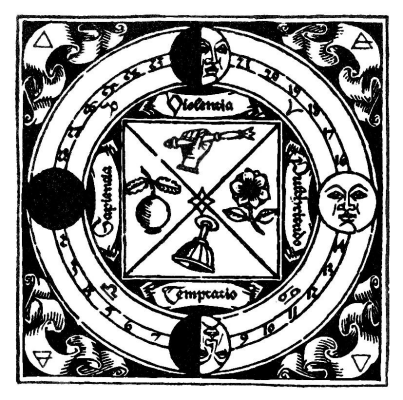
Edmund Dulac’s woodcut of the Wheel of the 28 Phases of the Moon (1937 version; A Vision B 66)
This web site is dedicated to the work of the Irish poet W. B. Yeats (1865-1939), specifically to the strange, esoteric system which he and his wife, George, created, and which he expounded in A Vision. It is intended primarily for students of this work, and also for those who are interested in the intellectual and symbolic background to his later poetry and prose. For those who are unfamiliar with Yeats or with A Vision, the Overview offers a brief introductory survey.
The System of Yeats’s A Vision lends itself to hypertext, and to the use of visual material and dynamic diagrams which it enables, since the organisation of the material is notoriously difficult in both editions of A Vision (the ‘A’ version of 1925 and the ‘B’ version of 1937: see The Two Editions). This can leave many readers frustrated by the use of terms which are poorly explained or explained elsewhere and by the lack of easy cross-referencing, areas which hypertext addresses very effectively.
In large part, however, the difficulty still remains, since: ‘A symbol system can only be understood and evaluated by entering its web of internal relationships and noting how and where external criteria impinge on it. The problem is that we cannot start with the complex whole all at once; and if we start at any one point, we immediately introduce distortions’ (The Construction of Reality). While hypertext links enable a more fluid approach, the individual reader still has to approach the material in some form of sequence. The topics on the main contents page are therefore arranged in a rough order of ascending development, from the fundamentals of the System to their effect upon Yeats’s vision of reality.
Turning and turning in the widening gyre The falcon cannot hear the falconer; Things fall apart; the centre cannot hold; Mere anarchy is loosed upon the world, The blood-dimmed tide is loosed, and everywhere The ceremony of innocence is drowned; The best lack all conviction, while the worst Are full of passionate intensity.
The mind, whether expressed in history or in the individual life, has a precise movement, which can be quickened or slackened but cannot be fundamentally altered, and this movement can be expressed by a mathematical form.
Note to ‘The Second Coming’, Michael Robartes and the Dancer [full text] (Dundrum: Cuala Press, 1922)
This site does not offer a hypertext of A Vision itself and does not aim to offer a substitute for Yeats’s A Vision; this is not only because of copyright reasons, but because the ‘book of A Vision’ is an artefact in itself (see The Book of Yeats's Vision by Hazard Adams). This link gives some notes about buying a copy over the internet .
Volume 14 of the Collected Edition of the work of W. B. Yeats, A Vision: The Revised 1937 Edition, edited by Margaret Mills Harper and Catherine E. Paul, came out in May 2015, still only in hardback (list price $60, but cheaper in many places) and e-book.
Volume 13 of the Collected Edition of the Works of W. B. Yeats A Vision A (1925), also edited by Margaret Mills Harper and Catherine E. Paul came out in 2008, and is now available in paperback and e-book. Further details are available at:
Scribner's/Simon and Schuster's page where the price is listed as $26.99 and the e-book is $14.99. (See my review of Volume 13.)
The pages here attempt to offer a clear and helpful guide to the ideas of A Vision and, in doing so, they sometimes extend and develop the material beyond what is explicitly contained in A Vision; some of the diagrams in particular represent significantly different reformulations of those created by the Yeatses.
The site does not aim to present a sustained argument either, although much of the material is associated with a doctoral thesis I presented at Oxford University; do contact me if you are interested in an electronic copy of the thesis.
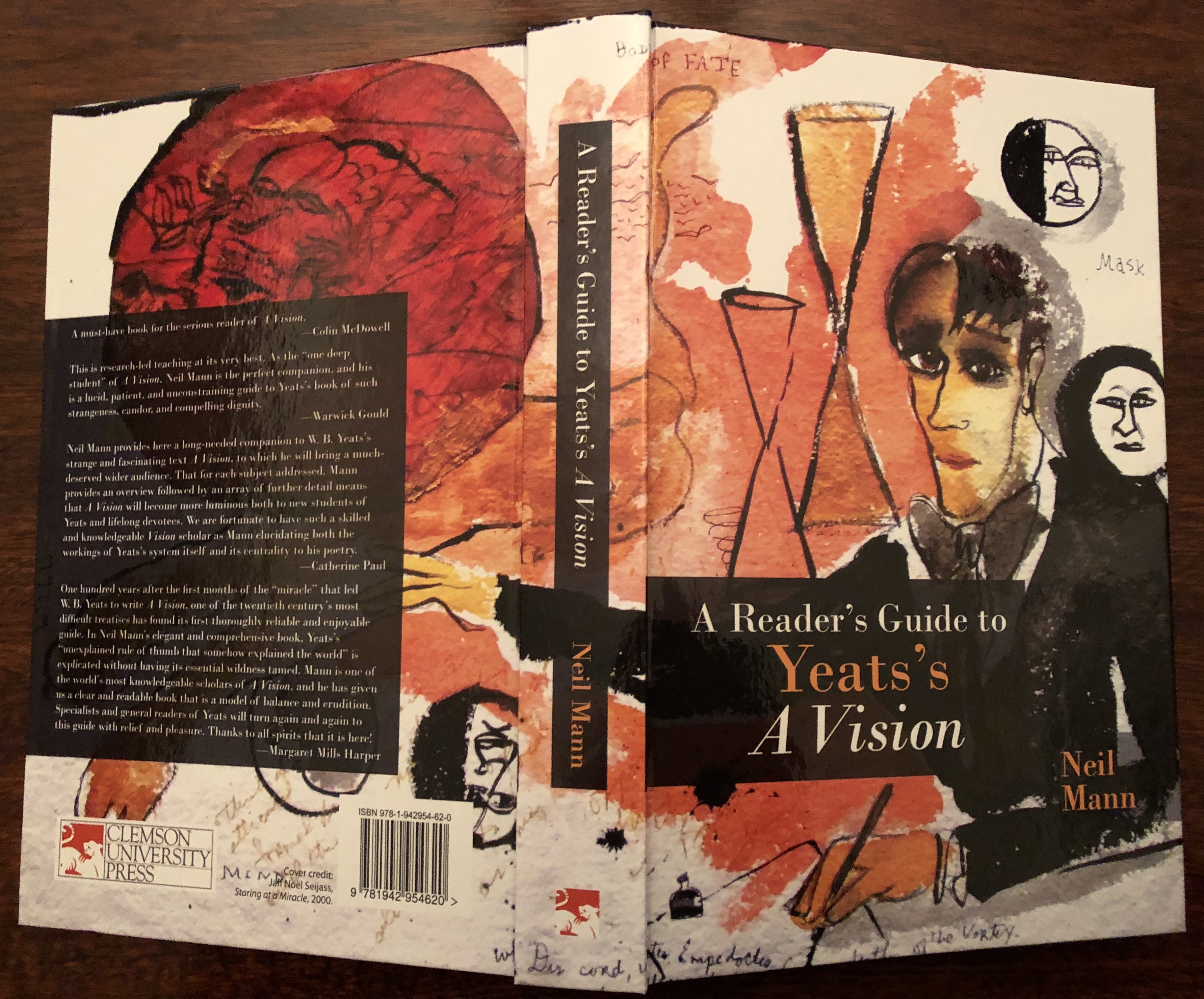
A Reader's Guide to Yeats's 'A Vision' Available in hardback, paperback, and e-book. (The paperback is both cheapest and corrects a few errors.)
February 2019: A new introduction to the context and system of A Vision.
A READER'S GUIDE TO YEATS'S A VISION CONTENTS
Background 1 Overview: The Book of A Vision 2 Genesis: Making and Remaking A Vision 3 Background: Antecedents and Assumptions
Foundations 4 Presentation: Gyres and Geometry
5 Spirits: Determinism and Free Will
6 Being: Human and Divine
Structure 7 The Faculties: Action and Pursuit
8 The Principles: Reality and Value
9 The Daimon: Opposition and Essence
10 The Divine: One and Many
Process 11 The Circles of Life: Wheels and Rebirth
12 The Twenty-Eight Incarnations: Lives and Phases
13 After Life: Understanding and Preparation
14 History: Cycles and Influx
Epilog 15 Reframing A Vision Appendix: People in Phases
A Reader's Guide to Yeats's 'A Vision' by Neil Mann is published by Clemson University Press.
The book is available from Liverpool University Press (July 2025: �26.40 for the paperback, $35.59 or $30.42), as well as through Amazon (both Amazon.com and Amazon.co.uk, though LUP is cheaper [in July 2025]), and other good booksellers.
An essential book for anyone starting out to read A Vision. . . . a must-have book for the serious reader of A Vision. — Colin McDowell
This is research-led teaching at its very best. As the "one deep student" of A Vision, Neil Mann is the perfect companion, and his is a lucid, patient, and uncompromising guide to Yeats's book of such strangeness, candor, and compelling dignity. — Warwick Gould
Neil Mann provides here a long-needed companion to W. B. Yeats's strange and fascinating text
A Vision, to which he will bring a much-deserved wider audience. That for each subject
addressed, Mann provides an overview followed by an array of further detail means that A
Vision will become more luminous both to new students of Yeats and lifelong devotees. We are
fortunate to have such a skilled and knowledgeable Vision scholar as Mann elucidating both the
workings of Yeats's system itself and its centrality to his poetry. — Catherine E. Paul
One hundred years after the first months of the "miracle" that led W. B. Yeats to write A Vision, one of the twentieth century's most difficult treatises has found its first thoroughly reliable and enjoyable guide. In Neil Mann's elegant and comprehensive book, Yeats's "unexplained rule of thumb that somehow explained the world" is explicated without having its essential wildness tamed. Mann is one of the world's most knowledgeable scholars of A Vision, and he has given us a clear and readable book that is a model of balance and erudition. Specialists and general readers of Yeats will turn again and again to this guide with relief and pleasure. Thanks to all spirits that it is here! — Margaret Mills Harper
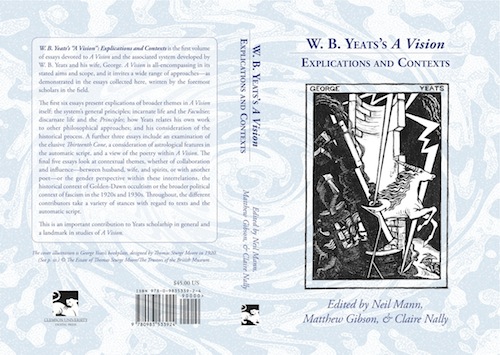
Yeats's "A Vision": Explications and Contexts is available for purchase and free download:
The first ever volume of essays devoted to aspects of A Vision has been written by a range of scholars who examine a variety of themes and approaches, edited by Matthew Gibson, Claire Nally and me. It is published by the Clemson University Press in South Carolina, under the aegis of the distinguished Yeats scholar Wayne K. Chapman, who has contributed to the volume as well. Apart from work by the editors and Professor Chapman, it also includes essays by Margaret Mills Harper, Catherine E. Paul, Nick Serra, Colin McDowell, Janis Haswell, Rory Ryan, Charles Armstrong, Matthew DeForrest and Graham Dampier. The book is published in both electronic and printed form. Check Clemson University Press's site for the title, where the electronic version is available for free download (here) and the paper version is available to order for $45 (+P&P). It is also accessible online via Liverpool Scholarhip Online and University Press Scholarship Online (simplest to search on "Yeats" and "Vision"; or click this direct link functional April 2016), though this is by subscription or through a library.
Though not focused specifically on A Vision like the previous volume, this book has much to offer those interested in Yeats's thought more broadly: most of the essays touch of matters of relevance to A Vision or contain sections on it, while two essays deal with aspects of history in A Vision.
"Something Intended, Complete": Major Work on Yeats Past, Present, and Yet to Come
Katherine Ebury
Ghost, Medium, Criminal, Genius: Lombrosian Types in Yeats's Art and Philosophy
Charles I. Armstrong
"Born Anew": W. B. Yeats's "Eastern" Turn in the 1930s
Neil Mann
W. B. Yeats, Dream, Vision, and the Dead
Matthew Gibson
Yeats, the Great Year, and Pierre Duhem
Graham A. Dampier
The Morphological Interaction of the Four Faculties in the Historical System of W. B. Yeats's A Vision
Colin McDowell
Yeats and Abstraction: From Berkeley to Zen
Appendix I (Chapman)
Annotation in the Writings of Walter Savage Landor in the Yeatses' Library
Appendix II (Gibson)
Yeats's notes on Leo Frobenius's The Voice of Africa (1913)
The Life and Works of W. B. Yeats
The National Library of Ireland, which, through the generosity of the Yeats family, holds the largest collection of Yeats’s papers and drafts, has mounted an excellent exhibition about Yeats, in all his aspects, which can be viewed on-line as a virtual tour of the physical exhibition in Dublin. It includes a fair portion on Yeats's esoteric interests, including A Vision. The exhibition opened on 25 May 2006 and its original closing date passed long ago as it is still open in 2025. (I have to acknowledge bias, from being involved with it, but it genuinely is very good.) See the Links page for further information and resources.
This website does NOT use cookies. The site-map gives a picture of the shape and extent of the site. Any comment is welcome, and please report any problems or broken links to the same address.
I have a (very desultorily updated) blog which explores aspects of A Vision and the Yeatses' System that do not fall within the more scholarly and factual ambit of this website. It examines elements of the system that interest me, particularly looking at parallels and how the System fits with esoteric and symbolic systems more generally. Whereas the website aims to offer clear and direct interpretation of A Vision for readers and students, confining itself largely to what Yeats himself wrote and to the academic study of his work, the comments and articles in the blog will be rather more speculative, exploratory and possibly personal. I add to the blog very slowly, and as it is far from topical and will only be minimally sequential, I hope that readers will feel able and welcome to respond to any post, whether it was nominally put up the day before or months or even years before. The blog is currently titled The Widening Gyre, even though that title has already been used quite a lot and I'm thinking about better alternatives, but the actual address is tied to this one: YeatsVision.blogspot.com.
All the images and quotations used on these pages are believed to be used legitimately within the laws of copyright. If you notice any that are not, please contact me and they will be removed.
I would like to thank Professor Warwick Gould at the University of London’s Institute of English Studies for his encouragement in the creation of these pages, and Colin McDowell for his helpful comments on them.
This site was created and written, and is maintained by Neil Mann (contact).